Southern Thai Food: The Fiery Cuisine Most Tourists Never Meet
Most visitors to Phuket eat Thai food for two weeks and never meet the cuisine of the place they're standing in. It's not their fault. The beach restaurants serve a greatest-hits version of central Thai cooking — green curry, pad thai, tom yum — adjusted to a heat level a holiday stomach can handle, and it's often good. But Phuket is not central Thailand. It's the deep south of the country, closer in spirit and flavour to Malaysia than to Bangkok, and the food the island's own people grew up on is a different animal: fiercer, more sour, more golden with turmeric, and built around the sea. Southern Thai restaurants are on every local street, feeding full tables of Phuket families every day. Tourists walk past them because the menus are in Thai, the photos on the wall mean nothing to them, and nobody warned them what they were missing. Consider this the warning — and the map.
What makes southern Thai cooking different
Put a southern Thai curry next to a Bangkok one and you can see the difference before you taste it. The southern plate runs gold and orange — that's turmeric, used fresh and in quantity, staining curries, fried fish, chicken and rice itself. Turmeric in the south isn't a background note; it's a headline flavour, earthy and slightly bitter, and it gets into everything a southern cook touches. A southern kitchen also works fresh coconut constantly — grated, squeezed, thrown into curries and salads — because the south is coconut country, palms all the way down the peninsula.
Underneath it all sits shrimp paste — kapi — the fermented foundation of southern seasoning. Central Thai cooking uses it too, but the south leans on it harder: in curry pastes, in chilli dips, in stir-fries, giving dishes a deep savoury funk that reads as richness once you're used to it. And then there are the chillies. The south cooks with bird's eye chillies by the handful, and southern heat is a different kind from the sweet warmth of a Bangkok curry. Central Thai food aims for a balance where sugar rounds the chilli off. Southern food doesn't round it off. The heat is meant to be met with rice, raw vegetables and other dishes — not tamed inside the dish itself.
Two more layers shape the southern table. Down the peninsula runs a Malay and Muslim influence: rich coconut curries, roti, slow-cooked beef, spices that came up the coast with traders. And in Phuket above all, a Hokkien Chinese layer from the tin-mining centuries — noodle shops, braised pork, sweets — which means the island's southern food has a Chinese counterweight sitting right beside it at the same table. Add the last element, the obvious one: the sea. Phuket is an island in the Andaman, and the southern kitchen is built on fish, prawns, crab and squid — fresh, whole, and often simply presented so the catch speaks.
The essential dishes, honestly explained
These are the dishes that define the southern table. Every one of them is on the menu at a local southern restaurant in Phuket, and most visitors have never heard of half of them.
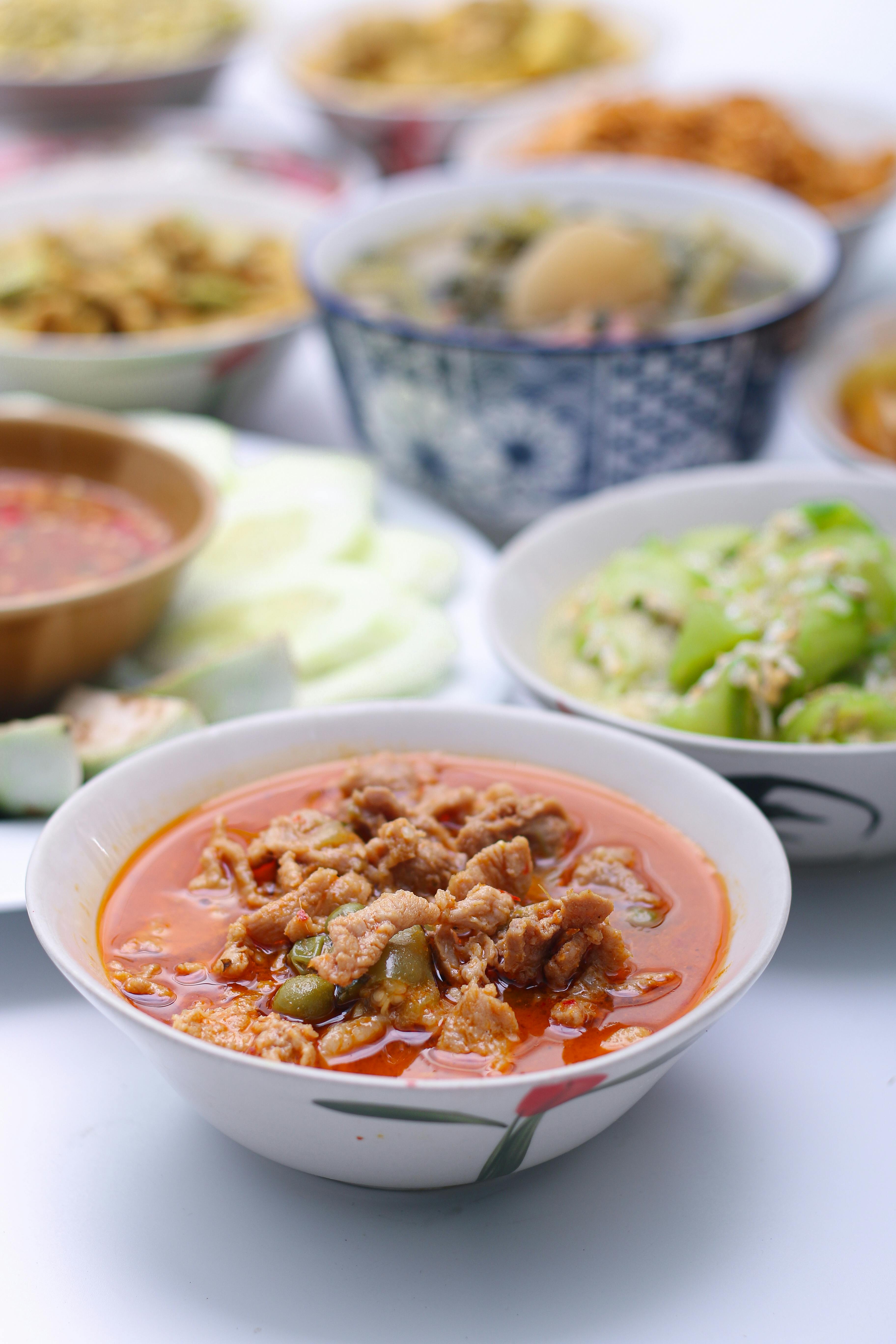
Gaeng som is the dish that introduces itself with a slap. It's a thin, fiery, sour curry — no coconut milk — coloured orange-yellow with turmeric and pounded chilli, soured hard with tamarind or lime, usually cooked with fish and a vegetable like green papaya, pineapple or bamboo shoots. First-timers expect something like tom yum and get something sharper, hotter and more austere. It's the south's signature dish, eaten at home more than anywhere, and it shocks people precisely because it isn't trying to please them. If you order one southern dish to understand the cuisine, this is it — but read the heat section below first.
Gaeng tai pla is the acquired taste, and it deserves respect rather than a dare. The curry is built on tai pla — the fermented innards of mackerel, salted and aged — which gives it an intense, dark, pungent depth. Cooked with fish, bamboo shoots, pumpkin, long beans and eggplant, it's one of the oldest and most beloved dishes in the south, and one of the saltiest, funkiest things in Thai cooking. Some visitors take one spoonful and are done. Others — often on the second or third try — find the depth addictive. Order a small bowl to share rather than committing a whole meal to it, and know that southerners rate a kitchen by this dish.
Khua kling is the dry one. Minced pork (sometimes beef) stir-fried in a wok with a fierce southern curry paste — turmeric, chilli, lemongrass, kaffir lime — until the meat is almost dry, intensely flavoured and fiery, finished with shredded lime leaf and fresh chillies. No sauce, no softness, just concentrated heat and spice clinging to every crumb of pork. It's a rice dish above all: you mix it through a mound of steamed rice and let the rice do the work. Order it once, properly hot, and you'll understand why southerners living in Bangkok seek it out like a letter from home.
Moo hong is the mercy dish, and it's Phuket's own. Pork belly braised low and slow in a dark, sweet sauce of soy, palm sugar and garlic until it collapses at the touch of a spoon. It comes from the island's Baba — Peranakan Chinese — kitchens, it has no chilli heat at all, and it exists on the southern table for the same reason it exists in this article: balance. Next to a bowl of gaeng som, moo hong's sweet richness resets your mouth completely. Every local will steer a first-timer toward it, and they're right.
Bai liang pad kai is the green that saves the meal. Bai liang — melinjo leaves, a southern vegetable with a soft, spinach-like texture and none of spinach's bitterness — stir-fried with egg and a little dried shrimp. It's gentle, savoury, slightly sweet, and it appears on southern tables the way a salad appears in the West: as the fresh counterpoint that lets the fiery dishes keep coming. If a southern restaurant puts one dish in front of every table almost by default, it's this one.
Sataw — stink beans — come with a warning and a celebration in the same breath. The bright green beans grow in long pods on tall trees across the south, and they're usually stir-fried with prawns, shrimp paste and chilli (pad sataw goong). The flavour is unique: garlicky, nutty, pungent, faintly bitter, unlike anything else on the plate. The "stink" part is honest — like durian's milder cousin, sataw announces itself in your breath and beyond for hours afterward. Southerners don't care, and once you've had a good plate of it, you might not either. Try it early in your trip, not the night before a flight.
Khao yam is the quiet masterpiece: the southern rice salad. A mound of rice — sometimes coloured blue with butterfly pea flower or golden with turmeric — surrounded by small piles of shredded herbs, kaffir lime leaf, lemongrass, dried shrimp, toasted coconut, bean sprouts, pomelo and chilli, dressed at the table with budu, a sweet fermented fish sauce from the far south. You mix it all yourself, and every bite is a different balance of sour, salty, sweet, herbal and crunchy. It's often a breakfast dish in the south, it's genuinely refreshing in the heat, and it's the southern plate with the fire turned down — proof the cuisine isn't only about chilli.
Phuket's own specialties within the south
Within the southern tradition, Phuket keeps a few dishes that are the island's alone. Mee Hokkien is the famous one: thick yellow noodles stir-fried in a rich, dark seafood-and-pork broth until the sauce clings to the noodles, loaded with prawns, squid and fish, a soft egg broken through at the end. It came off the boats with Hokkien migrants from Fujian by way of Penang, grew up in Phuket's noodle shops, and belongs here now. And for a sweet finish, look for o-aew: a shaved-ice dessert of clear jelly made from fig seeds and banana, served with red beans and grass jelly under syrup — a Hokkien import turned Phuket institution, and exactly what your mouth wants after a southern lunch.

How locals actually eat it
Understanding southern food means understanding the table, not just the dishes, because the southern meal is engineered as a system.
Rice is the coolant. A southern meal is built on a large plate or bowl of plain steamed rice per person, and the fiery dishes are eaten a spoonful at a time with the rice — never mouthful after mouthful of curry on its own. When a dish overwhelms you, the answer is not water. Water spreads chilli oil around your mouth and makes things worse. Rice absorbs it. So does anything sweet or fatty, which is why the system has a second part.
Sweet and mild dishes are the counterweight. A proper southern spread deliberately mixes fire with relief: gaeng som next to moo hong, khua kling next to bai liang. Nobody in the south eats a table of five fiery dishes in a row. If you're ordering with a local and they add a dish you didn't ask for, it's probably this — the balancing dish — and you should trust them.
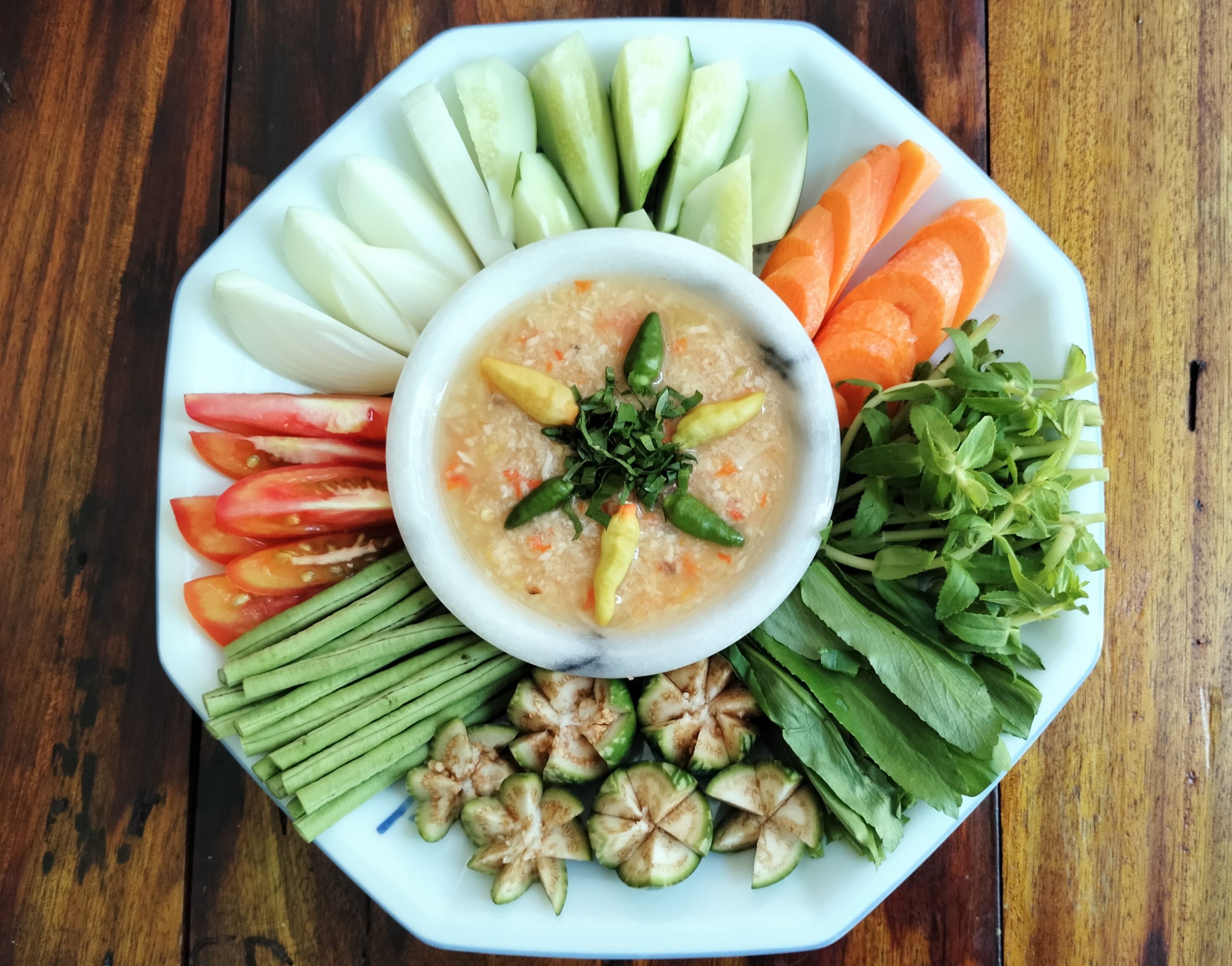
The pak naw tray comes free, and it's not decoration. At southern restaurants, a tray or platter of raw vegetables and herbs lands on the table without being ordered — cucumber, long beans, Thai eggplant, betel leaves, young cashew leaves, herbs you've never seen, sometimes a small bowl of chilli dip. This is pak naw, and it's functional: you eat the raw vegetables between bites of curry to cool and refresh your mouth, and to add crunch and green flavour the cooked dishes don't have. First-timers often leave it untouched, thinking it's garnish. Locals work through the whole tray. Do as the locals do.
The heat question, answered straight
Southern Thai spicy is a real thing, not a marketing line, so here it is plainly. A standard local gaeng som or khua kling is hotter — clearly, noticeably hotter — than the "spicy" versions of central Thai dishes served to visitors in resorts. It's hot enough that first-timers regularly abandon bowls. Asking for it pet nit noi — a little spicy — helps, but at a local place "a little" is measured on the southern scale, and the dishes also lose something when the paste is dialled right down, because chilli carries flavour here, not just heat.
None of that is a reason to stay away. It's a reason to order smart. Share dishes family-style so no single bowl is your whole meal. Keep moo hong or bai liang on the table as your reset button. Eat rice with every bite of the hot dishes and use the pak naw tray. And build up over the trip: by your third or fourth southern meal, what floored you on day one will taste like what it is — one of the great regional cuisines of Thailand, at full strength. The people who fall in love with southern food almost always started by being shocked by it.
Where a visitor finds the real thing in Phuket
You don't need a guide or a booking. The south's everyday institution is the southern curry-rice shop — khao rat gaeng: a counter of steel trays holding the day's curries and stir-fries, where you point at two or three dishes over rice and pay local prices, typically ฿50–100 for a plate with a couple of dishes. These shops open early, feed workers, taxi drivers and families, and mostly close when the trays run out in the early afternoon. If the trays hold an orange fish curry, a dry minced pork and something dark and fermented, you've found a southern one.
For a sit-down version, Phuket Town is the island's southern-food capital — the city where the island eats its own food, with long-running local restaurants serving full southern menus alongside the Baba and Hokkien dishes the Town is famous for, at prices set for locals. The rule that works all over Phuket works doubly here: walk two streets back from the tourist strip, look for the place that's full of Thai families at noon, and go in. At markets and local restaurants, dishes are usually pictured or displayed in trays, so pointing works fine. Learn three words and you're set: gaeng som, moo hong, and ao pet nit noi — "a little spicy, please."
Two ways to order your first southern meal
For the brave: Start with gaeng som with fish and pineapple — the signature, at full local heat, no adjustments. Add khua kling to mix through your rice, a plate of pad sataw goong if the beans are in season, and bai liang pad kai as your one act of self-preservation. Work the pak naw tray. Finish with o-aew if you pass a shop selling it on the way out. That's the deep end, and it's glorious.
For the careful: Lead with khao yam — all the southern flavours, barely any fire — or a khanom jeen set with fish curry and the full spread of vegetables. Order moo hong as your main, bai liang pad kai on the side, and ask for a small taste of gaeng som from a shared bowl rather than a whole one of your own. You'll leave having genuinely eaten southern food, not a tourist edit of it, and you'll know exactly how much further you want to go next time.
Because there usually is a next time. Southern Thai food is the cuisine most tourists never meet — and the one a good number of them end up liking best, once somebody finally introduces them.
Staying in Patong and want to eat your way across the island? Phuket Town's southern kitchens are about forty minutes away — and PhuketLive.com covers the whole island's food, beaches and nights to plan around the meals.


Comments
Post a Comment