Phuket Town's Food Scene: The Old Town Restaurants Worth Crossing the Island For
Ask a Phuket local where the island's best food is, and they won't point at the beach. They'll point inland, at the city most tourists drive through on the way from the airport and never properly enter. Phuket Town — and its Old Town core — is where this island actually eats. The beach towns feed visitors, and some of them do it well. Phuket Town feeds Phuket: three and four generations of the same families, at the same tables, ordering the same dishes their grandparents ordered. If you only give the island's food culture one day of your holiday, spend that day here. This guide is the case for crossing the island for lunch — and the map for what to do when you arrive.
Why the capital of Phuket food isn't on the coast
Phuket got rich on tin, not tourism. Through the 1800s and into the 1900s, the tin mines drew thousands of Hokkien Chinese workers and merchants from Fujian, by way of Penang and the Straits settlements. They settled in what became Phuket Town, built the shophouses you still walk past today, married into local Thai families, and cooked. The result was a culture with its own name — Peranakan, or Baba (Baba for the men, Nyonya for the women) — and a cuisine to match: Chinese technique and ingredients run through southern Thai heat and local produce, pork belly braised in dark sweet soy next to curries that would make a Bangkok cook blink.
That heritage is why Phuket Town's food is different from everywhere else in Thailand. Bangkok food is royal Thai and street Chinese layered over centuries. Chiang Mai food is Lanna. Phuket Town food is a port city's food — Hokkien noodle shops, kopitiam coffee culture inherited from Penang, Muslim curry houses, Indian roti makers, and Baba home cooking that was never restaurant food at all until the restaurants started serving it. UNESCO naming Phuket a Creative City of Gastronomy in 2015 was mostly a certificate for what Phuket Town had been doing for a hundred years.
The other reason is simpler: the Town never had to please tourists. Prices stayed local, flavours stayed unadjusted, and the morning dim sum houses still open for the working city, not for visitors. You are a guest at a table that exists without you — which is exactly why the food is honest.

The morning: dim sum, kopi and the city's real breakfast
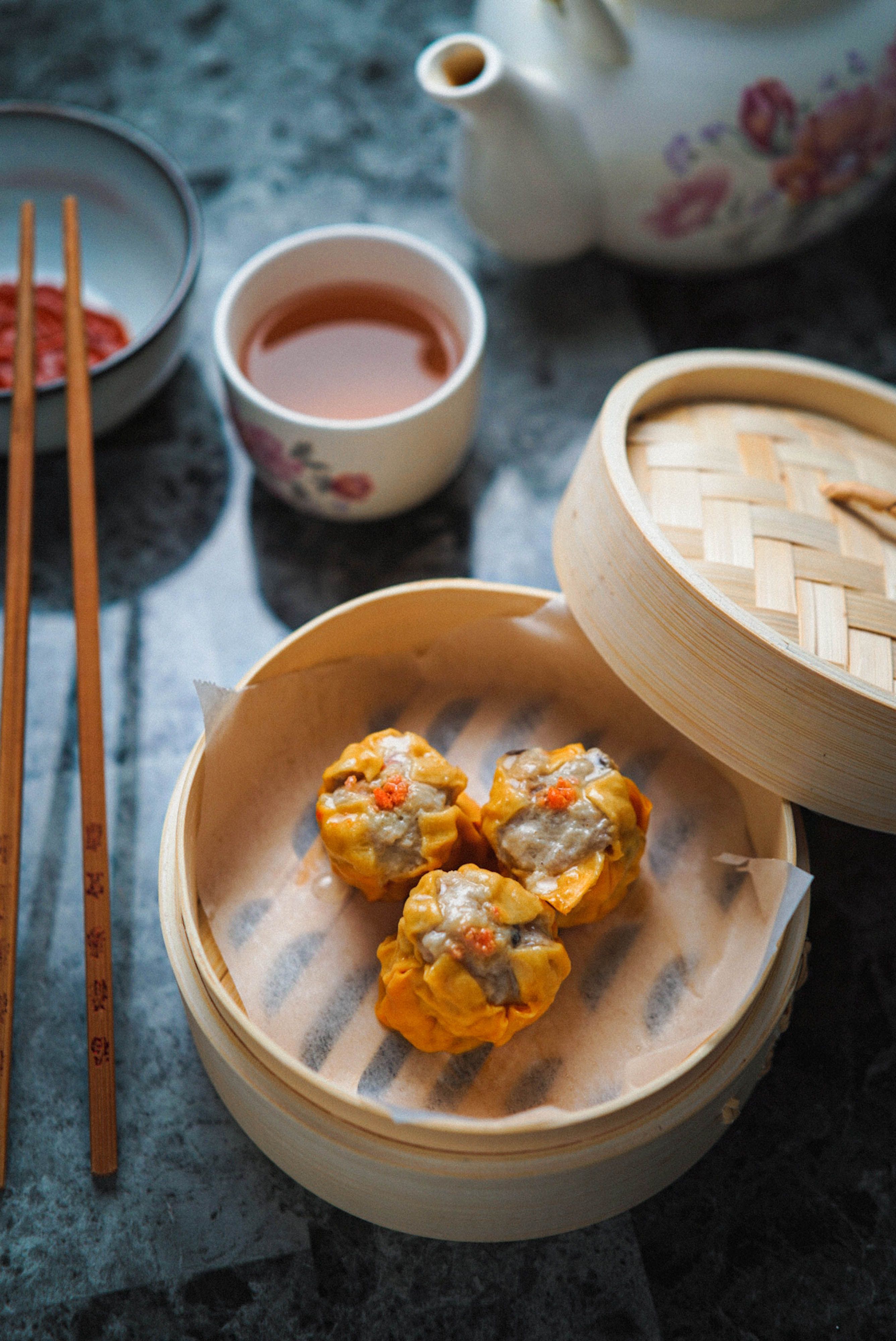
Phuket Town wakes up eating, and if you arrive at noon having slept through it, you've missed a third of the story. The day starts around 6 AM in the dim sum houses — open-fronted shops, fans turning, steam rolling off stacked bamboo baskets. The system is the same everywhere: sit down, order tea or coffee, and the baskets start arriving — har gow, siu mai, steamed pork buns, rice rolls, fried items from the kitchen — and you take what you like and wave off what you don't. The empties stack up on your table and are counted when you pay. A full dim sum breakfast with tea typically runs around ฿100–200 a person, and you'll be surrounded by Phuket families, office workers and school-run grandparents, not other tourists.
Next door, or just down the street, are the kopi shops — the old Hokkien coffee houses. Order kopi the old way: thick, strong coffee sweetened with condensed milk, or teh tarik-style pulled tea, with kaya toast (coconut jam on crisp toast) or soft-boiled eggs cracked into a saucer with soy and white pepper. Some kopi shops double as roti places, and a roti with a bowl of chicken or beef curry, eaten with sweet milky tea, is the other great Town breakfast — a legacy of the Muslim and Indian cooks who set up alongside the Chinese. Typical breakfast at a kopi shop: around ฿60–120.
The local rule is that breakfast is a social meal, taken early, taken unhurried, and taken in company. Get to the Old Town by 7:30 or 8 AM, pick the dim sum house or kopi shop with the most locals in it, and start your food day the way the city starts its own.
The dishes that belong to Phuket Town
Every Thai city has noodle soup and rice with curry. These are the dishes that are Phuket Town's own — the ones with the city's name effectively written on them.
Hokkien mee is the signature. Thick yellow noodles stir-fried in a rich, dark seafood-and-pork broth until the sauce clings rather than pools, loaded with prawns, squid, fish and pork, with a soft egg broken through it and a squeeze of lime at the end. It's a Hokkien migrant's dish that grew up in Phuket, it costs roughly ฿60–100 a bowl at the old noodle shops, and no visit to Town is complete without it. Eat it where the woks have been black for decades.
Moo hong is the Baba dish visitors understand instantly: pork belly braised low and slow in a sweet, dark sauce of soy, sugar and garlic until it gives at the touch of a spoon. It's the mercy dish of southern cooking — rich, gentle, no chilli — and the one every local will steer a nervous eater toward first. It was wedding and festival food in Baba homes long before restaurants served it, and it still tastes like a family recipe, because it is one.
O-tao is the dish even most Thais outside Phuket have never had: small oysters fried with taro in a soft, savoury batter, crisped at the edges, served on bean sprouts with a chilli sauce. It's a night-market and old-shop special, typically around ฿80–150, and it's genuinely hard to find beyond the island. If you see it, order it — you may not get a second chance on this trip.
Khanom jeen is Phuket's breakfast-into-lunch staple: soft fermented rice noodles with curry ladled over — fish curry is the classic, crab curry the luxury — and a spread of raw vegetables, herbs, boiled eggs and pickles on the table to load on as you like. The Town's khanom jeen shops let you mix curries, and a plate runs about ฿40–80. It's also the dish that explains the local palate: fermented, fiery, herbal, fresh, all at once.
Lo ba is the deep-fried end of Hokkien snacking: seasoned pork offal and cuts — braised first, then fried crisp — served with a sweet-spicy dipping sauce and pickled cucumber. It's a beer snack, a market snack, a dish for people who grew up with it, and it's better than it sounds by a wide margin.
Phuket-style satay differs from the satay you'll meet elsewhere in Thailand: the pork is marinated richer and sweeter, the skewers are grilled over real charcoal, and it comes with the proper peanut sauce plus the sharp cucumber-onion-chilli relish that cuts the sweetness. Sold by the set — ten sticks or so — for roughly ฿60–120 at stalls and old shops around Town.
That is six dishes, and you could eat all six in a single well-planned day in a few blocks of the Old Town. Locals would approve of the attempt.

Street by street: eating the Old Town
The Old Town is small — four or five streets that matter — and each has its own flavour. Walk it hungry and in the morning or late afternoon, when the heat backs off and the shutters open.
Thalang Road is the postcard street: pastel Sino-Portuguese shophouses, and on Sunday evenings, the Walking Street. By day it mixes old businesses with cafés and sweet shops — look for the traditional bakeries selling Hokkien and Baba sweets, pineapple tarts, and mooncake-style pastries whose recipes came off the boats from Penang. This is the street to snack as you walk.
Dibuk Road is where the old money lived, and it shows — the grandest shophouses and mansions, and some of the Town's most storied local restaurants, including long-running kitchens serving full Baba menus: moo hong, crab curry, stir-fried morning glory with shrimp paste, the works. If you're choosing one sit-down lunch to understand what Baba food is, Dibuk is the street to choose it on. Expect roughly ฿250–500 a person for a proper spread with rice and drinks.
Phang Nga Road is the working street — banks, shrines, hardware shops — threaded with the morning food culture: dim sum houses, kopi shops, noodle stalls and one of the city's beloved roti-and-curry breakfast spots near the old market end. Come here between 7 and 10 AM; by afternoon the breakfast city has gone home to rest.
Yaowarat Road, named for Bangkok's Chinatown, is the old commercial spine: gold shops, Chinese medicine halls, shrines — and the noodle shops and rice-and-curry counters that feed the people who work them. It's the least polished street and, for everyday eating, possibly the best value: a Town worker's lunch here sits around ฿50–100.
Woven between the streets are the shrines — the Jui Tui and Put Jaw shrines near the market are the spiritual centre of the Vegetarian Festival — and the morning market itself, where a walk with coffee in hand, watching the island's produce, seafood and curry pastes come in, is a food education that costs nothing.

Sunday evening: Walking Street
On Sunday from late afternoon, Thalang Road closes to traffic and becomes Lard Yai, the Sunday Walking Street — the Old Town's weekly party, and the single easiest way to graze the Town's food in one pass. Stall after stall runs down the middle of the street between the lit shophouses: o-tao fried to order, satay smoking over charcoal, Hokkien sweets, southern curries, grilled seafood, roti, coconut ice cream, juices, and the fried insects that every visitor photographs and the brave ones eat (crunchy, salty, honestly fine). Prices are market prices — most things land between ฿40 and ฿150 a portion — and the crowd is half the island, out for its Sunday stroll. Buskers play, kids run around, and the whole thing feels like what it is: a city feeding itself for fun. Arrive around 5 PM before the crush, eat in small portions from many stalls, and keep walking.
The Michelin effect
The Michelin Guide covers Phuket, and a good share of its Phuket listings sit in or near the Town — including Bib Gourmand recognition for small, humble places where a full meal costs little and the cooking is serious, as well as listed family restaurants serving exactly the Baba and southern dishes above. The Guide's arrival didn't change how these places cook; it changed who queues for them. Treat the listings as a useful cross-check rather than a ranking: the Town's food culture is older and wider than any guidebook, and some of the best bowls in the Old Town have no sticker on the door, just forty years of regulars. If a Bib Gourmand shophouse has a queue at lunch, it's earned it — join the queue, it's rarely long by big-city standards.
One perfect food day in Phuket Town
- 7:30 AM — Breakfast. Dim sum and sweet tea at a busy Phang Nga Road house, or roti with curry and pulled tea at a kopi shop. Eat with the city, not before it.
- 10:00 AM — The market walk. Wander the morning market and Thalang Road while it's still cool-ish: a kopi refill, a Baba sweet or two from an old bakery, and no plan beyond looking.
- 12:30 PM — Lunch. Hokkien mee at an old noodle shop, or a full Baba lunch on Dibuk Road — moo hong, crab curry with betel leaf, rice, and something green and stir-fried. Follow with o-tao if you see it frying.
- 4:00 PM — Snack o'clock. Phuket satay by the set, or khanom jeen if you skipped it, plus iced tea. The afternoon heat is for sitting in a fan-cooled shophouse, not marching.
- 6:30 PM — Dinner. On a Sunday, Walking Street is dinner: graze it. Any other night, pick a Town seafood or southern kitchen and order gaeng som if you're brave, moo hong if you're wise, and both if there are two of you — that pairing is the whole cuisine on one table.
Total damage for the day, eating generously at local places: roughly ฿600–1,200 a person. The same appetite spent on beachfront restaurants buys about half the food and a tenth of the story.
Practical notes before you go
Getting there and parking: Phuket Town is roughly 30–45 minutes from Patong and the west-coast beaches by car, less from the island's centre. Parking in the Old Town is the one genuine annoyance — streets are narrow and the free library/municipal lots and side streets fill by mid-morning on weekends. Come early, or take a taxi or ride-hail and save the circling for somebody else. On Sunday evenings, park a few streets out and walk in.
Heat and timing: the Old Town is a walking district with little shade. Do the streets before 11 AM or after 4 PM, retreat to air-conditioning in between, and carry water. The food day above is built around exactly that logic.
Cash and paying: the Town's old shops run on cash and PromptPay QR — carry small notes; cards are for the newer restaurants and cafés. Prices at local places are fixed and low; the by-weight rules that matter at seafood markets elsewhere matter less here, where menus are printed and portions priced.
Dress and manners: this is a living city, not a theme park — the shophouses are homes and businesses, and the shrines are working temples. Shoulders covered for shrine visits, photos asked for politely, and a smile and a few words of Thai (aroi means delicious, and cooks love hearing it) open more doors than any app.

Worth crossing the island for
People come to Phuket for the beaches, and the beaches are lovely. But the beach towns will feed you the way beach towns everywhere feed people. Phuket Town feeds you the way a port city with 150 years of Hokkien, Baba, Muslim and southern Thai cooking feeds itself — dim sum at dawn, Hokkien mee at noon, satay in the afternoon shade, and a whole street of food on Sunday night. Cross the island for it once, early in your trip. Most people who do, cross back again before they leave.
Planning the trip around the eating? PhuketLive.com covers the whole island — beaches, boating, golf and nightlife — and if you're staying in Patong, you can be on Walking Street by taxi in about forty minutes and back on the beach by dark.


Comments
Post a Comment